

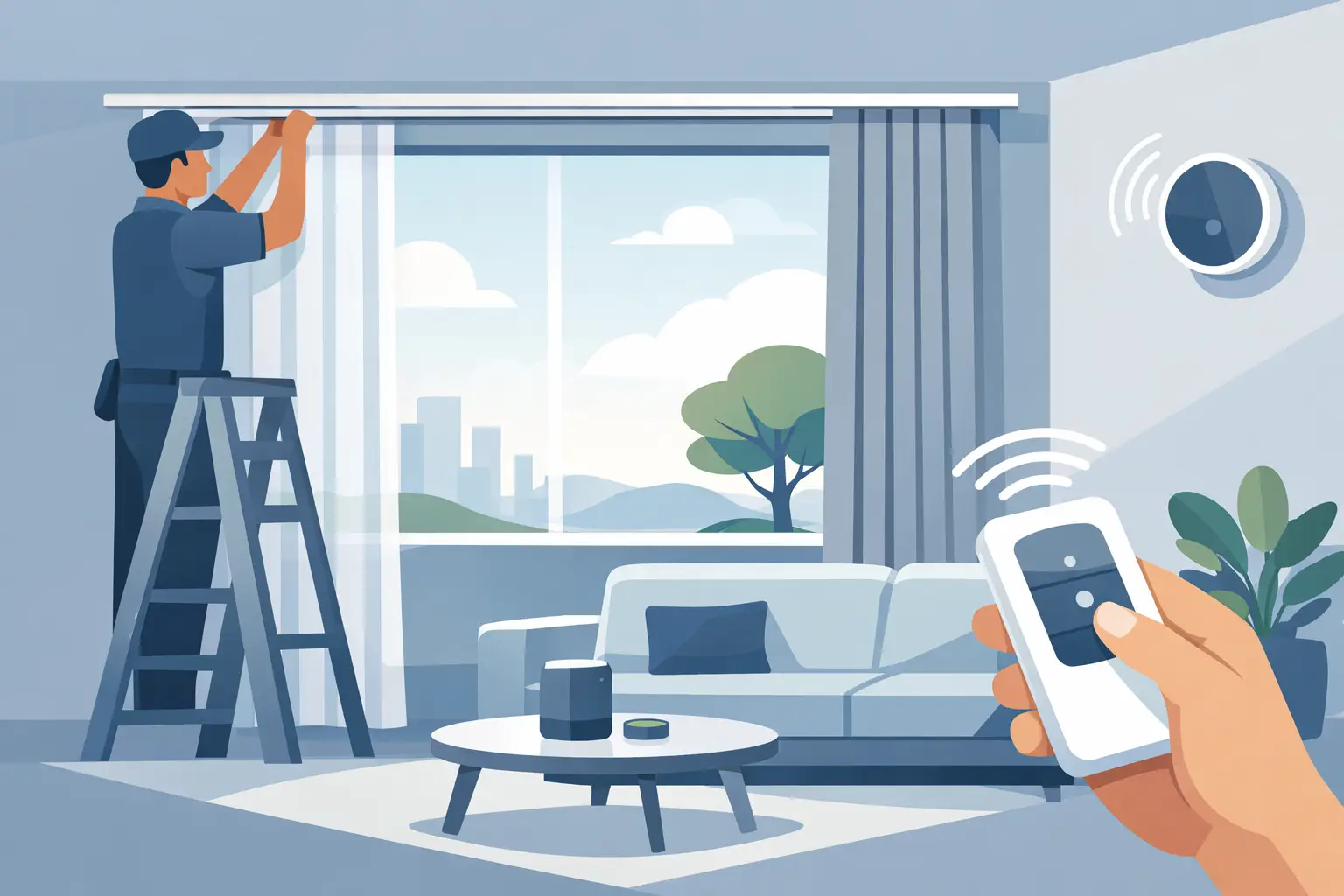
A curtain that stops halfway across a tall window, bunches at one end, or leaves a strip of glare at the side can make an otherwise polished room feel unfinished. Professional motorized curtain installation solves that problem at the source: the track, motor position, fabric weight, power planning, and final calibration all work as one system.
For modern homes, condominiums, hospitality spaces, and large residential projects, motorized curtains are not simply a convenient upgrade. They are a practical way to control heat, privacy, daylight, and atmosphere without interrupting the architecture of the room. With the right installation, a wide glass wall can shift from open and bright to private and restful at the touch of a button.
Why the Installation Matters as Much as the Curtain
A motorized curtain system looks simple once it is complete. The curtains open smoothly, close evenly, and disappear into a ceiling recess or sit neatly below a curtain pelmet. Behind that clean result is careful planning.
The curtain track must be straight, securely fixed, and properly sized for the opening. The motor needs enough capacity to move the selected fabric without strain. The curtain stack must have room to park when open, particularly beside balcony doors, corner glazing, or full-height windows. If any of these details are overlooked, even premium fabric and a high-quality motor can underperform.
This is why motorization should be considered early in a renovation, new build, or interior design project. Power points can be concealed, ceiling pockets can be sized correctly, and the curtain layout can follow the room’s true function rather than becoming an afterthought.
Plan the Curtain System Around How the Room Is Used
The right curtain arrangement depends on more than window width. A bedroom, double-volume living room, home theater, and penthouse balcony-facing lounge each need a different balance of blackout, privacy, view preservation, and solar control.
For bedrooms, a blackout curtain paired with a sheer layer is often the strongest combination. The sheer softens daytime glare and maintains a degree of privacy, while the blackout layer creates a darker sleeping environment at night. A dual-track motorized system lets each layer move independently, so the room can change throughout the day without manual adjustment.
In living areas with broad glass façades, motorized curtains help manage direct sun before heat builds up indoors. Sheers can remain closed during the brightest hours to diffuse harsh light while keeping the space connected to the view. At night, heavier curtains create privacy and a more intimate setting.
For difficult locations such as high windows, stairwells, double-volume spaces, and windows behind furniture, motorization is the clear answer. These are the openings where manually operated curtains are often left in one position because they are inconvenient to reach. Automation turns them into functional shading instead of decorative fabric.
Motorized Curtain Installation Starts With Accurate Measurement
Measurements are not limited to the width and height of the glass. The installer must assess the full wall, ceiling condition, track position, curtain return, and the amount of fabric required to achieve a full, elegant closure.
Track width needs to extend beyond the window where possible. This allows the curtain to stack clear of the glass when open, preserving daylight and view. A track that ends exactly at the window edge may leave fabric covering part of the opening even when the curtains are fully drawn.
Ceiling height also affects the result. Full-height curtains generally create a stronger architectural line and make a room feel taller. In many contemporary interiors, ceiling-mounted tracks are preferred because they eliminate visual clutter and give the curtains a refined, built-in appearance.
The fabric itself must be measured with the correct fullness. Too little fabric can look flat and sparse. Excessive fullness can make the curtain stack bulky and increase the load on the system. The goal is a tailored finish that moves smoothly and still has enough body when closed.
Choose the Right Track, Motor, and Power Method
The curtain track is the foundation of the system. It should be selected for the window shape, curtain weight, and installation condition. Straight tracks suit standard walls and sliding doors, while curved tracks can follow bay windows, rounded corners, and architectural curves. For exceptionally wide openings, a properly configured system may use one motor with a central opening or side opening, depending on access and fabric layout.
Motor selection should match the curtain weight and daily use. A lightweight sheer in a guest room does not require the same capacity as lined blackout curtains spanning a large living-room façade. Oversized or double-layer systems need dependable motors designed for sustained, quiet operation.
There are two main power approaches. Wired motors are an excellent choice when electrical planning is available during construction or renovation. The wiring can be concealed for a clean finish, making this option especially suitable for new homes, show units, hotels, and larger projects.
Rechargeable battery motors offer flexibility where running new electrical wiring is impractical. They can be a smart solution for completed interiors, smaller openings, or spaces where minimal disruption is a priority. The trade-off is that batteries require periodic charging, while wired systems provide continuous power. The best choice depends on the project timeline, access to power, and expectations for daily operation.
Smart Controls Should Make Daily Life Easier
A good motorized curtain system should feel natural to use. Wall switches, handheld remotes, and smart-home control can be selected according to the homeowner’s preference and the wider automation setup.
For many households, timed scenes are the feature that quickly becomes indispensable. Curtains can open in the morning to bring in daylight, close during peak afternoon sun, and draw again at night for privacy. This is particularly useful in rooms that receive strong western sun or in homes that are vacant for part of the day.
Voice control and app control can add another layer of convenience, but they should not be the only way to operate the curtains. A simple wall control remains valuable for guests, children, and anyone who wants immediate access without reaching for a phone.
For property developers, hospitality operators, and designers, centralized control offers consistency across multiple rooms or units. It also supports a more considered guest experience: blackout curtains can close at bedtime, sheers can open with morning light, and shared spaces can respond to changing daylight conditions with minimal staff intervention.
Avoid Common Motorized Curtain Installation Mistakes
The most common mistake is installing the track before confirming the curtain design. A track may be positioned too close to the wall, too near an air-conditioning unit, or too far forward from the window. This can cause the fabric to rub, hang poorly, or leave unwanted light gaps.
Another issue is underestimating the curtain stack. When a large curtain opens, the fabric needs a parking area. If there is a wardrobe, feature wall, or balcony-door handle at the side, the layout must account for it before installation begins.
Power is another frequent consideration. A beautiful ceiling pocket loses its impact if a visible cable must run down the wall afterward. Where possible, identify power locations before plastering, ceiling work, or cabinetry installation.
Finally, do not treat curtain fabric as a purely decorative choice. Heavy fabrics, blackout linings, wide openings, and double tracks affect the system’s load and movement. The motor, brackets, and track should be specified as a complete package, not selected independently.
A Clean Finish Comes From Final Calibration
Once the track and curtains are installed, the work is not finished. The opening and closing limits must be set so the curtains stop exactly where they should. The fabric should meet neatly at the center for a center-opening design, or fully clear the glass for a one-way opening design.
Final testing also checks for smooth travel, noise, alignment, and proper remote or switch response. This is the stage where a system becomes effortless rather than merely operational. Small adjustments to carriers, hooks, curtain heading, or limit settings can make a visible difference to the finished result.
Smart Curtain Malaysia approaches motorized shading as part of the architecture, not an accessory added after the room is complete. From elegant sheers and blackout curtains to large-scale tracks for high windows and glass façades, the right system creates comfort that looks intentional.
A well-planned motorized curtain installation gives every window a purpose: soften the sun when the room needs calm, protect privacy when evening arrives, and reveal the view when it is time to enjoy it.