

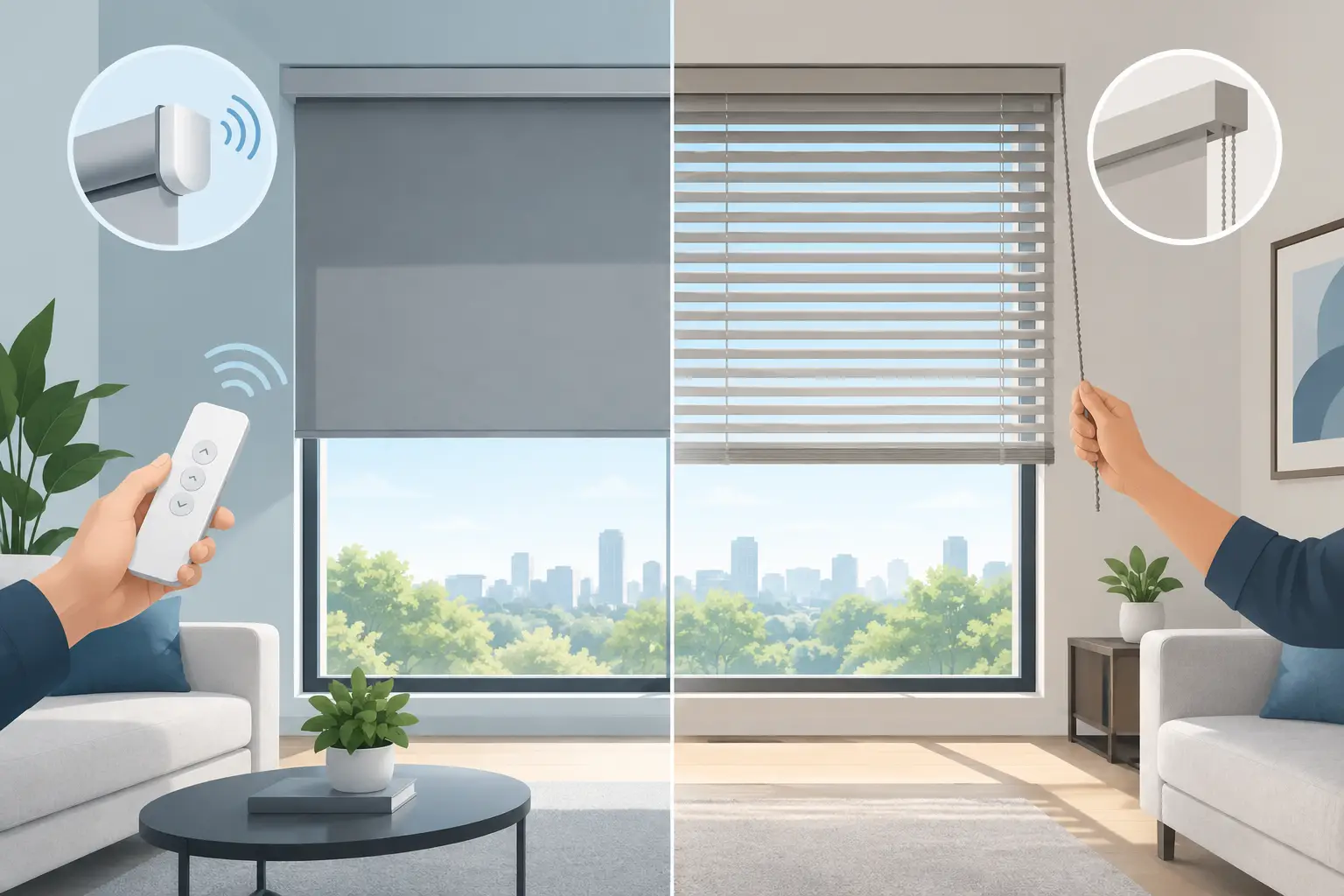
A wall of glass can make a living room feel spectacular at 9 a.m. and unbearably hot by 2 p.m. The real question behind automated blinds versus manual blinds is not simply whether a motor is more luxurious. It is whether your shading system can control heat, glare, privacy, and atmosphere at the exact moment your space needs it.
For a compact bedroom window, a manual blind may be the sensible choice. For a double-height façade, a sun-facing condo, a skylight, or a balcony that needs daily protection, automation changes how the entire space performs. The right decision depends on the window, the lifestyle, and the level of control your project demands.
Automated Blinds Versus Manual Blinds: The Real Difference
Manual blinds are operated by hand, usually with a chain, cord, wand, or direct pull. They are familiar, straightforward, and effective for accessible windows that are opened and closed occasionally. A well-selected manual roller blind, zebra blind, honeycomb blind, or wooden blind can provide strong privacy and light control without adding electrical requirements.
Automated blinds use a motor to raise, lower, open, tilt, or position the fabric through a remote, wall switch, app, voice control, or programmed schedule. Their advantage is not just convenience. Automation makes shading practical in locations where manual operation is awkward, time-consuming, or impossible – including tall windows, wide sliding doors, ceiling systems, skylights, and high-rise glazing.
The distinction becomes most visible when sunlight changes throughout the day. A manual blind only works when someone is available to adjust it. An automated system can close before afternoon glare reaches the sofa, open gradually in the morning, or lower every evening to create instant privacy.
When Manual Blinds Are the Better Choice
Manual blinds remain a smart, cost-effective solution when the window is within easy reach and the room does not require frequent adjustment. A guest bedroom, a small study, a low-level kitchen window, or a rental unit may not need connected controls to perform well.
They also suit homeowners who prefer a simple, mechanical solution with no charging, wiring, remote pairing, or smart-home setup. With fewer components, manual systems can be easier to specify for basic projects and may carry a lower upfront cost.
Design still matters. A manual blind does not have to look ordinary. Clean roller blinds can sharpen a minimalist interior, zebra blinds can alternate between filtered daylight and privacy, and honeycomb blinds can add insulation while maintaining a soft, structured appearance. The key is choosing the correct fabric openness, blackout level, and mounting method for the room.
However, manual operation loses its appeal when blinds are large, heavy, high, or numerous. Pulling multiple blinds across a wide façade every day can become a chore. In those cases, people often leave the blinds in one position, which means the shading system is no longer responding to the room’s changing conditions.
Where Automated Blinds Take the Lead
Automated blinds are designed for spaces where performance needs to happen without effort. They are especially valuable for sun-facing rooms, homes with floor-to-ceiling glazing, double-volume living areas, penthouses, and architectural windows that are difficult to access safely.
A motorized system makes it easy to use your blinds more often and more precisely. Instead of fully opening or closing a shade, you can lower it to the exact point that blocks glare while preserving the view. That control is valuable in living rooms, home offices, dining spaces, and media rooms where daylight is welcome until it interferes with comfort.
For bedrooms, automated blackout blinds or curtains can be programmed around waking and sleeping routines. For a family arriving home after work, one command can create privacy across several windows. For hospitality, show units, and premium developments, synchronized shading delivers a finished, high-value experience that manual operation cannot match.
Automation is also the clear answer for skylights and ceiling blinds. These installations are typically beyond normal reach, yet they receive direct heat and intense sunlight. A motorized skylight shade helps manage that exposure without ladders, poles, or inconvenient daily effort.
Better Heat and Glare Management
Blinds do not replace insulation or air conditioning, but they can reduce the solar load entering a room. When a shade closes before direct sun heats the glass and interior surfaces, the room is easier to keep comfortable. This is particularly relevant for large windows, west-facing façades, glass roofs, and exposed condominium units.
Automated schedules make this benefit more consistent. You can set blinds to lower during the hottest period and lift later when the sun moves away. Manual blinds can achieve a similar result, but only if someone remembers to operate them at the right time.
Privacy That Responds to Your Routine
Privacy is not only a nighttime concern. Ground-floor homes, urban apartments, and closely positioned neighboring buildings may need selective screening throughout the day. Automated blinds allow a room to move from open-view living to private comfort in seconds.
This is particularly useful for wide window walls and sliding doors. Rather than walking from panel to panel, a single control can position the entire system. The result feels intentional, not improvised.
Cost, Installation, and Maintenance Considerations
Manual blinds usually cost less at the point of purchase because they do not require motors, controls, or electrical planning. They are often faster to install in straightforward locations. If budget is the deciding factor and the windows are accessible, manual operation remains a practical choice.
Automated blinds require a more considered specification. The motor type, blind size, fabric weight, power source, control method, and installation location all matter. Some systems use rechargeable battery motors, while others are wired for continuous power. Wired solutions are ideal when planned during renovation or construction; battery options can be useful for completed homes where opening walls is undesirable.
Maintenance is generally manageable for both options when the system is correctly sized and installed. Fabric should be cleaned according to its material, and moving components should not be forced. For motorized blinds, professional measurement is critical. An underspecified motor or poorly aligned system can affect smooth operation, especially on wide or tall installations.
The cheapest option is not always the most economical over time. A manual blind may cost less initially, but an automated system can offer better daily use in rooms where light and heat conditions change constantly. The value comes from selecting automation where it genuinely solves a problem rather than adding it to every window without purpose.
How to Choose the Right System by Space
Start with access. If the blind can be reached comfortably and is only adjusted once or twice a day, manual operation may be enough. If it is above a stairwell, behind furniture, over a high window, or installed across a large glazed area, automation is usually the better investment.
Next, consider the room’s purpose. Bedrooms benefit from blackout scheduling and morning opening routines. Home offices need responsive glare control. Living rooms with expansive views may need precise positioning rather than an all-or-nothing shade. Outdoor areas may require purpose-built systems that address sun, rain, wind, insects, and privacy, not just indoor light control.
Finally, consider the project as a whole. A single motorized blind can be useful, but a coordinated shade strategy is more powerful. Smart Curtain Malaysia designs shading systems around the architectural condition – from roller and honeycomb blinds to skylight, ceiling, and outdoor guided solutions – so the result looks integrated while solving the actual exposure problem.
A Better Question Than “Which Is Best?”
Automated blinds are not automatically superior for every window, and manual blinds are not outdated. The best system is the one you will use consistently. Put automation where reach, heat, glare, privacy, or scale make manual control impractical. Keep manual blinds where simplicity and easy access make them the more sensible fit.
Before choosing, stand in the room at the time the sun is strongest. Notice where the glare lands, which windows feel exposed, and which shades would be inconvenient to adjust every day. That short exercise often reveals exactly where a motorized solution will make your home feel cooler, calmer, and far more considered.