

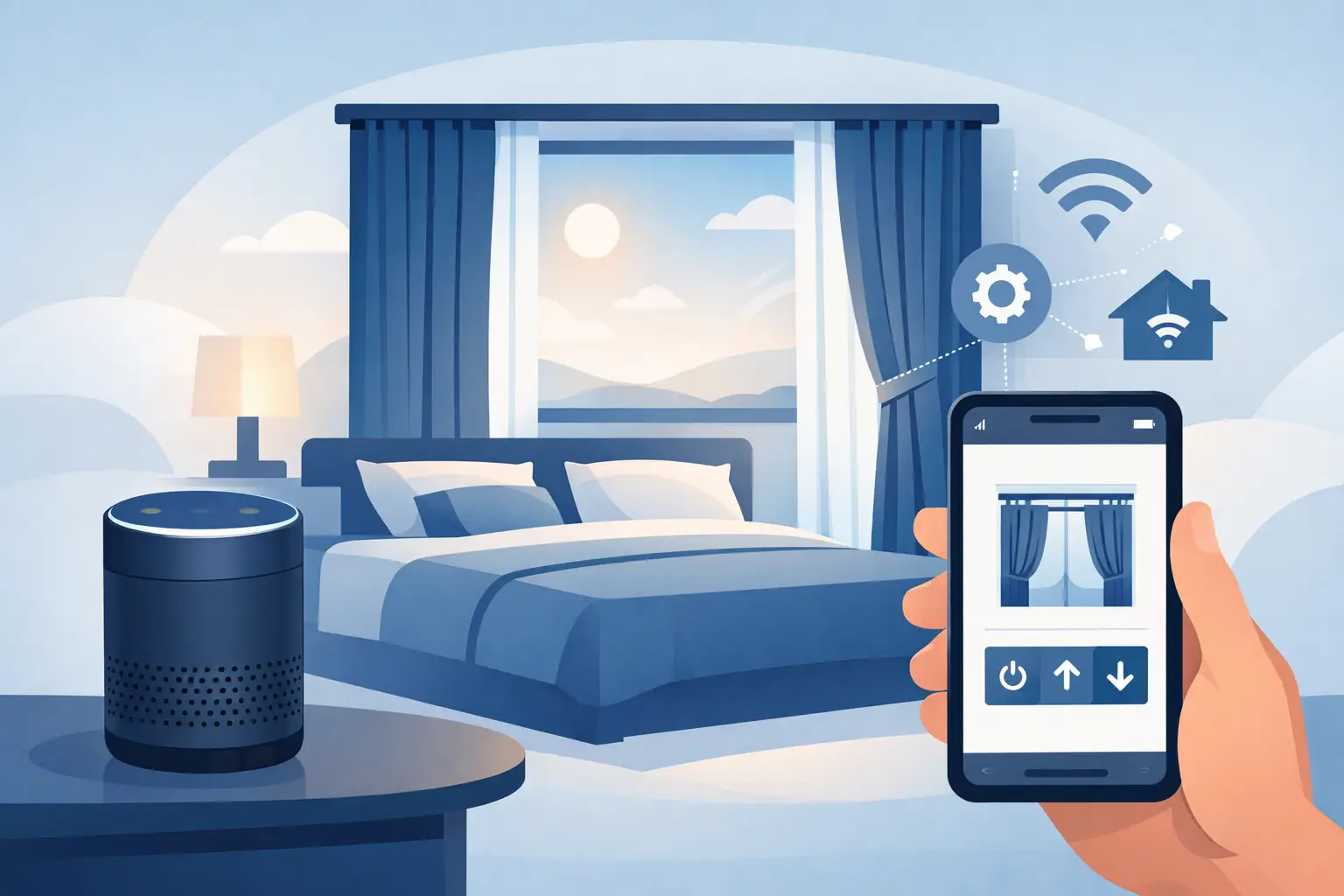
A bedroom should not begin with harsh sunlight, a difficult-to-reach curtain pull, or a scramble for privacy at night. Learning how to automate bedroom curtains gives you control over light, heat, and atmosphere with one tap, a voice command, or a schedule that works quietly in the background. Done properly, an automated curtain system feels less like a gadget and more like part of the architecture.
Start With the Bedroom Problem You Want to Solve
Motorized curtains can do several jobs at once, but the best system begins with a clear priority. A west-facing bedroom may need strong afternoon heat control. A ground-floor room may need instant nighttime privacy. A master bedroom may need blackout performance for deeper sleep, while a tall condo window may simply need a better way to operate curtains that are impossible to reach by hand.
For most bedrooms, the goal is a combination of light management and privacy. Sheer curtains soften daylight and preserve a bright, elegant feel during the day. Blackout curtains create a darker, more protected room at night. A dual-track motorized system lets both layers work independently, giving the bedroom the flexibility to shift from open views to filtered light to full blackout.
Do not choose automation before deciding what the curtain itself must achieve. A beautiful fabric that does not block enough light will still leave you waking early. A heavy blackout fabric on an undersized motor may move slowly, strain the system, or fail to close cleanly over time.
How to Automate Bedroom Curtains With the Right Track
The curtain track is the foundation of the entire installation. It determines how smoothly the curtains travel, where they stack when open, and whether the finished look feels clean and intentional. For modern bedrooms, a ceiling-mounted track is often the strongest choice because it creates a taller visual line and helps reduce light gaps above the curtain.
Measure the full width of the area you want to cover, not only the glass. Extending the track beyond each side of the window gives the curtain space to stack away from the view. It also improves side coverage when the curtains are closed. In a compact bedroom, this detail matters because a wide curtain stack can block daylight even when the system is fully open.
Consider the curtain layout before ordering the motorized track. A center-opening arrangement creates a balanced, hotel-style appearance and works well for wide windows. A one-way opening curtain is useful when furniture, a built-in wardrobe, or a wall limits where the fabric can collect. For corner windows, bay windows, or curved architectural features, the track design needs to follow the room rather than force the room to suit a standard curtain.
Choose Single or Dual Tracks
A single motorized track is suitable when one curtain layer is enough, such as a blackout curtain in a guest room or a privacy curtain in a small bedroom. A dual-track system is the more complete solution for primary bedrooms and design-led interiors. It separates the sheer and blackout layers so each one can respond to changing conditions.
Open the blackout curtains in the morning while keeping the sheers closed, and the room receives soft daylight without feeling exposed. Close both layers at night, and the bedroom becomes darker, more private, and more insulated from the outside world.
Select a Motor That Matches the Curtain Weight
The motor should be specified around the curtain size, fabric weight, track length, and opening style. This is not the place to guess. Lightweight sheers need less pulling power than full-height blackout drapery with lining. Wider openings, extra-tall ceilings, and double-layer systems also increase the load.
A properly matched motor delivers quiet, consistent movement. That matters in a bedroom, where a noisy motor can turn a premium feature into an early-morning irritation. Look for a system designed for smooth starts and stops, particularly if you plan to run it on an automatic schedule.
Power is the next decision. Hardwired motors are ideal for renovations, new builds, and major interior projects because the power source can be concealed for a refined finish. They are dependable for daily use and remove the need to recharge batteries. Battery-powered motors can be a practical option for completed rooms where opening walls or ceilings is not desirable, although they require occasional charging and may not be the best fit for very large or heavy curtains.
If the bedroom has several automated windows, hardwiring usually produces the cleanest long-term result. If it is one existing window in a finished condo, a battery motor may make more sense. The right choice depends on access, curtain size, and how polished you want the installation to look.
Plan Controls Around Real Daily Routines
Automation is most useful when it follows how you actually use the bedroom. A remote control is simple and reliable. Wall switches offer a familiar, built-in control point near the bed or door. App control gives you access from anywhere in the home. Voice control can be useful when you are already in bed and want to close the room without getting up.
The strongest setup combines manual access with automated routines. Technology should make a bedroom easier to live in, not leave you searching for your phone when you want to block the sun. A wall control or remote ensures that the curtains remain convenient for everyone in the household, including guests.
Schedules are where smart curtains become a daily comfort system. You might set sheers to open at sunrise, blackout curtains to open 20 minutes later, and both layers to close before sunset. For shift workers, families with young children, or anyone who needs uninterrupted rest, schedules can be customized around sleep hours rather than daylight.
Avoid treating every schedule as fixed. Seasonal sun angles change, and bedrooms facing east or west can become uncomfortable at different times of year. Adjust the timing as needed, or pair the system with sensors and a smart-home platform if the project calls for responsive light and temperature control.
Use Fabric to Control More Than Light
The motor moves the curtain, but the fabric determines much of the bedroom experience. Blackout fabrics are the clear choice when darkness is the priority. They are especially effective near streetlights, in urban apartments, and in bedrooms where morning sun arrives early. For the best result, allow adequate overlap at the sides and top of the window, because even high-performance blackout fabric cannot stop light that enters around the edges.
Thermal lining or denser curtain materials can also help reduce the feeling of radiant heat near large windows. Curtains are not a replacement for proper glass performance or air conditioning, but they are a valuable layer of comfort. When closed during strong sun, they reduce glare and help the room feel more protected.
Sheers deserve equal attention. A well-chosen sheer gives the bedroom a soft daytime glow, protects privacy from nearby buildings, and makes the transition between open and closed curtains feel more considered. The result is a room that remains bright without putting the interior on display.
Prepare the Installation Before the Curtains Arrive
The most elegant motorized curtain system is planned before final painting, ceiling work, and furniture placement. Confirm where power will be located, whether the track will be recessed or surface-mounted, and how the curtain will clear window handles, air-conditioning units, built-in cabinetry, and headboards.
For recessed tracks, allow enough ceiling pocket depth and width for both the motor and the curtain fullness. A narrow recess may look minimal in a drawing but create rubbing fabric or difficult servicing later. If you are adding a dual track, make sure each layer has enough space to move freely.
Check for obstructions along the entire curtain path. Curtains can catch on bedside lamps, protruding window handles, wall-mounted air-conditioning units, or decorative ledges. A professional site measurement is especially valuable for tall windows, corner glazing, ceiling-height curtains, and projects where the track must align perfectly with cove lighting or a false ceiling.
Keep Manual Use Simple
Even an automated system should allow easy operation during a power interruption or when a guest is unfamiliar with the controls. Depending on the motor and track design, curtains may be operated by gently pulling the fabric or through a designated manual function. Ask about this before selecting the system, rather than assuming every motor behaves the same way.
Make Automation Feel Like Part of the Bedroom Design
Bedroom automation works best when it disappears into the room. Concealed tracks, coordinated fabric colors, and carefully positioned motors keep the visual focus on the window treatment rather than the hardware. In a modern home, the curtain can run from ceiling to floor, frame the full wall, and make an ordinary window feel more generous and architectural.
This is also why curtain stack-back deserves attention. When the curtains are open, they should reveal the view rather than sit heavily across the glass. When closed, they should fall evenly, with enough fullness to look luxurious but not so much bulk that the motor is overloaded.
For a complete result, choose the system as one package: track, motor, fabric, control method, and installation details. Mixing these decisions at the last minute often leads to exposed wiring, poor coverage, or a motor that does not match the curtain weight.
A bedroom curtain should do more than open and close. Set it up to welcome softer mornings, protect private evenings, and create the dark, cool retreat you want at the end of the day.